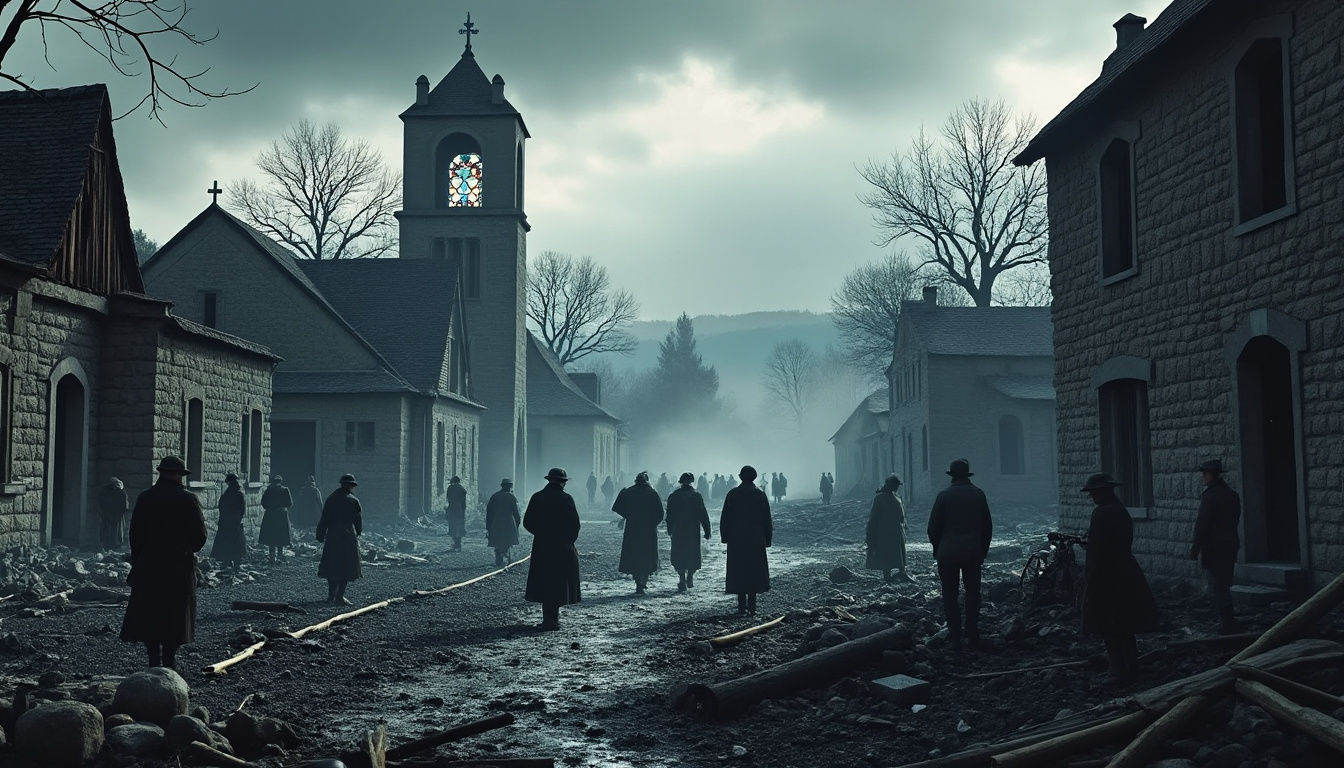
Oradour-sur-Glane: analysis of the film that retraces a tragic episode of French history in 1944 — The film and the documentaries that revisit the massacre of June 10, 1944, still question the way collective memory is transmitted. Through the journey of survivors, the use of archival footage, and contemporary fiction, these works seek to convey the scope of the tragedy without falling into sensationalism. This article dissects the artistic and ethical choices of a cinema that confronts the viewer with Nazism, the massacre of civilians, and the role of the French resistance, while raising the question of the duty of memory. Here you will find keys to understanding the different formats (documentary, fiction), points of attention to judge the accuracy of the narrative, and avenues to extend the reflection after the screening.
- Context: on June 10, 1944, in Oradour-sur-Glane, the most significant massacre of civilians in France under occupation.
- Key works: filmed testimonies such as “A Life with Oradour” and recent fictions that reignite the debate.
- Issues: representation of Nazism, responsibility of the actors, respect for the victims.
- Key points: quality of archives, voice of survivors, historical rigor are essential for a successful historical film.
- Resources: press articles and film sheets for further exploration.
Understanding the film and its historical context related to Oradour-sur-Glane
June 10, 1944, marks the destruction of the village of Oradour-sur-Glane and the massacre of many civilians. The films that revisit this event take different paths: testimonial documentary, factual reconstruction, or inspired fiction.
A documentary like A Life with Oradour follows the journey of a survivor, filming the ruins and memorials to give a voice to memory. These visual and narrative choices emphasize direct testimony and the weight of time.
Insight: to understand these films, one must distinguish between historical narrative and artistic intention, then verify the use of archives and the place given to survivors.
Why do these works engage the public and the press in 2024-2026?
The regular return of cameras to Oradour can be explained by the gradual disappearance of direct witnesses and the desire to transmit memory to new generations. The anniversary of 2024 has reignited the production of films and documentaries on the subject.
Recent articles have covered the filming of new fictions and the local reception of the teams. For example, the meeting between a well-known artist and the villagers generated significant coverage in the regional press.
Matt Pokora explains his film to the inhabitants of Oradour
Insight: local reception is a good indicator of the relevance of a historical film: it reveals whether the treatment is considered respectful and useful for memory.
Advantages, limitations, and points of attention in the cinematic treatment of the massacre
A film can illuminate, but also simplify or dramatize. It is useful to evaluate several aspects to judge the quality of the narrative.
- Advantages: humanization of the victims, preservation of memory, access to visual archives.
- Limitations: risk of anachronism, imagined scenes that may distort historical perception.
- Points of attention: clear mention of sources, involvement of historians, respect for the memory of the victims.
Insight: a good balance between emotion and documentary rigor is essential to avoid reducing the tragedy to a mere dramatic device.
Practical modalities: how are these films made and what sources are used?
Filmmakers combine several types of materials: living testimonies, archival images, shots in the ruins, and reconstructions. The quality of the film often depends on the verification of archives and transparency towards the viewer.
Teams rely on local institutions and archival funds to legitimize their work. Recent documentary films have also multiplied interviews with historians to contextualize the event in the Second World War.
Insight: methodological rigor (cited sources, distinction between archives/reconstruction) is the guarantee of a respectful treatment of the duty of memory.
Concrete examples and reference works on Oradour-sur-Glane
Several titles serve as references when addressing Oradour in cinema. Some rely on the words of survivors, while others use fictional writing to question the present.
To consult a detailed file on the documentary dedicated to the memory of the massacre, an online resource offers a complete and critical presentation.
file of the film “A Life with Oradour” on AlloCiné
Insight: comparing several works allows for the identification of approaches (direct testimony vs. fiction) and refines one’s critical perspective.
Comparative table: three works to know
| Film | Year (prod) | Type | Angle |
|---|---|---|---|
| A Life with Oradour | 2010 (release 2011) | Documentary | Testimony of a survivor, shot in the ruins |
| Oradour, Don’t Forget Me | 2025 (filming) | Fiction | Contemporary reinterpretation mixing personal drama and history |
| Commemorative documentaries | Multiple (articles 2024-2026) | Documentary | Reflection on the transmission of memory and the duty of memory |
Practical tips for watching and analyzing a film about Oradour-sur-Glane
Before the screening, inform yourself about the format: documentary or fiction? Does the director state their sources? These elements influence the spectator’s interpretation.
- Check for the presence of authenticated archives and the mention of sources.
- Prefer works that give voice to survivors or historians.
- Avoid works that transform the tragedy into a mere dramatic pretext.
- After the screening, compare the film to press articles or critical sheets to nuance your reading.
Insight: a viewing accompanied by historical context and critical analysis enriches understanding and respects the memory of the victims.
Common mistakes to avoid and best practices
Two errors often arise when receiving these films: taking fiction for a historical account and forgetting the human dimension in favor of spectacular effects.
Best practices:
- Consider the technical sheet and the intention declared by the director.
- Research the cited sources and expert interviews.
- Favor nuance: a work can be powerful without being historically exhaustive.
Insight: the vigilance of the viewer is the best guarantee against historical simplifications.
Resources and readings to deepen the subject
To follow recent debates about the staging of the massacre and the relationship between the teams and the inhabitants, several articles and regional portals publish investigations and reports.
Among the sources to consult: a report that examines the filming of a fiction and a local dossier on the transmission of memory.
article on the filming of a fiction that sparked reactions
a documentary film questioning the duty of memory
Insight: cross-referencing local press, film sheets, and official archives allows for a complete and respectful reading.
What are the differences between documentary and fiction on Oradour-sur-Glane?
The documentary emphasizes testimony, archives, and historical analysis, while fiction uses invented elements to question the present. Both can be complementary if the production respects the accuracy of the facts and the dignity of the victims.
How to verify the reliability of a historical film about the massacre?
Consult the technical sheet, the list of sources, the presence of historians or authenticated archives, and the reception from local actors. Specialized reviews and institutional resources often provide useful insights.
Can violent scenes be shown without betraying the memory of the victims?
Yes, if these scenes serve an approach of explanation and testimony, without sensationalism. Respect for families and transparency about the reconstruction are essential.
Where to find reliable archives and resources on Oradour-sur-Glane?
Regional portals, press files, and memorial institutions provide documents. Professional film sheets and national archive libraries are also good sources.