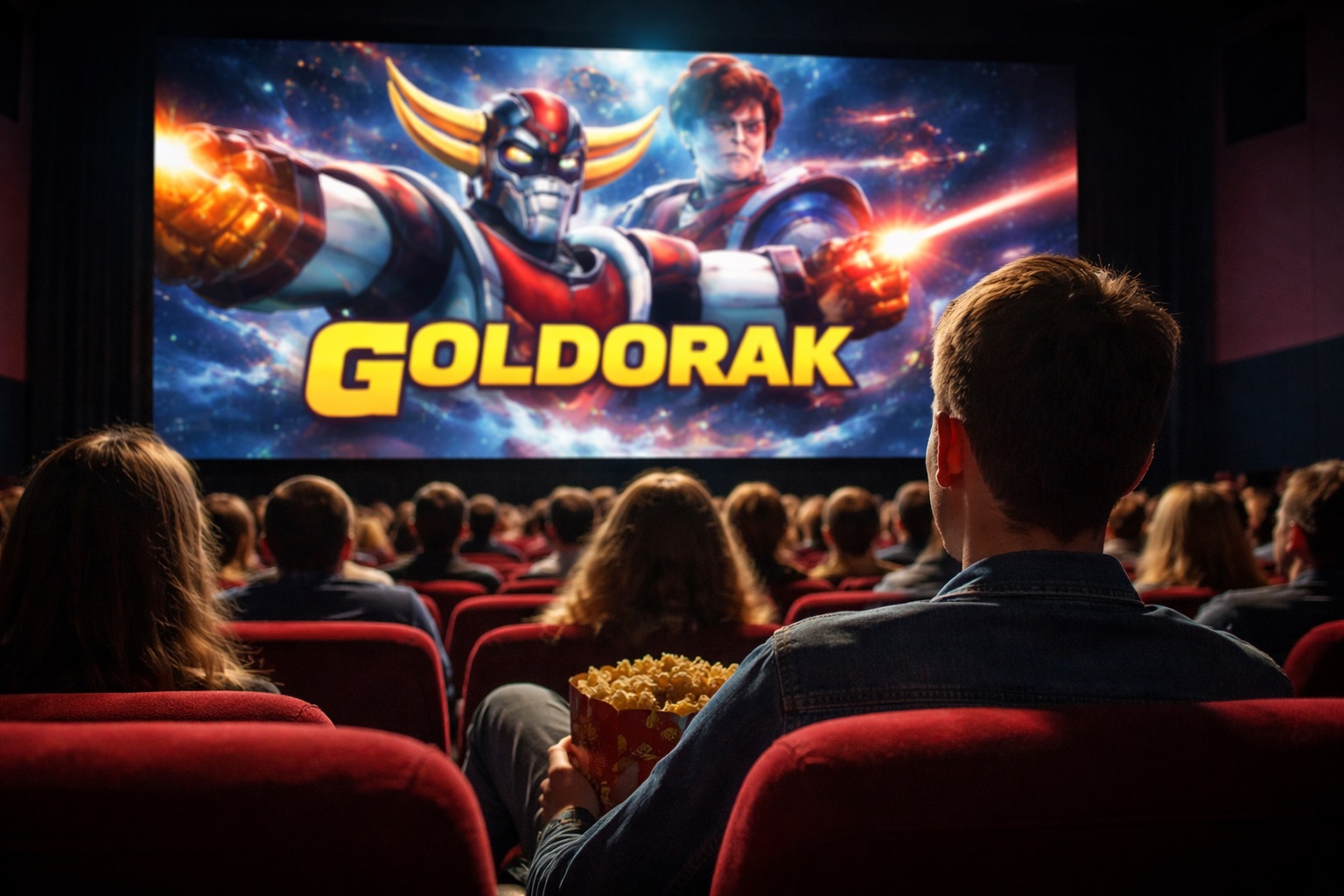
The metallic roar of the flying saucer still resonates in the collective ear: when Goldorak made its thunderous landing in cinemas at the end of the 1970s, it did not just entertain the audience; it shattered the certainties of the audiovisual industry. At that time, few believed that a “Japanese cartoon” could fill red seats like a Hollywood blockbuster. Yet, the steel stallion of Prince Actarus proved otherwise, propelling Japanese animation beyond the small screen and sowing the seeds of a craze that, even today, shows no signs of waning.
An Unexpected Audiovisual Revolution
The success of this imposing two-hundred-ton robot was not merely a generational whim; it revealed a thirst for new stories and heroes from elsewhere. In a France still marked by Franco-Belgian comics, the screening of the feature film derived from the television series triggered an aesthetic shock: bolder colors, staging worthy of a science fiction opera, terrifying enemies from the Vega Empire. The audience discovered a universe where the action was not limited to the screen: it resonated like an echo of their own anxieties about the cold war, the space race, or the search for identity. Parents, often skeptical, emerged dumbfounded; the children, however, had only one idea: to relive those blazing ascents, those lightning punches, those dying planets with purple skies.
Beyond the screening, the craze materialized in schoolyards: exchanges of sticker cards, passionate debates about the outcome of the final battle, and most importantly, a hunt for merchandise. This frenzy paved the way for a nascent market of Japanese licenses in Europe. Specialized newspapers dedicated their front pages to this “machine of the future”; sociologists saw it as a symptom of cultural globalization. And while the television series garnered record audience shares each night, the film further broadened the circle of enthusiasts, mixing curious onlookers, novices, and purists around a shared fervor. Among the sought-after treasures, the articulated Goldorak figurine was at the top: a fetish piece for reenacting the great cosmic rides at home.
The Narrative Alchemy of an Exiled Hero
Under the titanium armor hides Actarus, the fallen prince of the planet Euphor. This figure of an exile speaks to all those who, at some point, had to leave their home or redefine their identity. The author :contentReference[oaicite:1]{index=1} weaves here a tragedy worthy of ancient myths: a man, bearer of a heavy past, conceals his rank under a farmer’s mask to protect his host land. In the darkness of the theater, this story of welcome and resilience found an immediate echo. Between two stellar duels, the film distills the idea that otherness is not a weakness but a richness. The viewer emerges with the impression of having witnessed not only a robotic adventure but also a parable on tolerance.
The Fusion of Technique and Emotion
The direction entrusted to :contentReference[oaicite:2]{index=2} unfolds a spatial choreography of wild precision: tracking rails, circular panoramas, flare effects on celluloid. Each meteor attack is a note in a composition of brass and synthesizers, composed by maestro Shunsuke Kikuchi. The robot itself becomes an instrument, its roars mingling with the horns to amplify the tension. This organic union between image and sound heralded the path for modern blockbusters that place the soundtrack at the heart of the sensory experience.
A Mirror for Society in 1979
Against a backdrop of oil crisis and technological progress, France questioned its own modernity. Goldorak, the steel giant governed by a human pilot, crystallized this dilemma: how to tame a runaway science without losing one’s soul? The film, by showing the machine bending to the values of a prince driven by justice, offered a reassuring answer: technique is only dangerous when it disconnects from ethics.
The Theater Phenomenon: Figures and Repercussions
Upon its release, the feature film amassed nearly a million entries in just a few weeks, competing with the most popular national comedies. Even operators in small towns had to schedule additional screenings to meet demand. The queues snaked onto the sidewalks, reminiscent of those created two years earlier by :contentReference[oaicite:3]{index=3}. This tidal wave validated the idea that a manga could be profitable outside its archipelago of origin, opening the door to other licenses:
- Captain Harlock
- Cobra the pirate
- City Hunter
. Distributors began searching for new treasures to import, paving the way for the future democratization of anime in the 1990s.
Heritage and Reissues: Restored Memory
Over time, some original reels had become tarnished. In 2012 and again in 2024, remastered versions were screened during special nights, accompanied by discussions led by pop culture historians. These events demonstrated that the aura of the robot had lost none of its brilliance: parents and children gathered, sharing, for the duration of a screening, the same awestruck clamor. Streaming platforms now offer it a second wind, while 4K Blu-ray editions achieve respectable sales figures. The cleaned sound archives highlight the triumphant brass of the theme song, which, like a bugle, awakens an undiminished nostalgia.
A Red Thread Between Generations
The beauty of this work lies in its ability to weave bridges. The pioneers, now in their forties or fifties, pass the universe on to their children as one bequeaths a family legend. At conventions, it is not uncommon to see a father donning Actarus’s armor while his daughter sports Alcor’s colors. This intergenerational symbiosis reminds us that a story, when it strikes a chord, survives the passage of time more surely than an extraterrestrial metal. The machine then joins the myth: it is passed from mouth to mouth, from screen to screen, like a flame that one protects from the wind to pass on to the next.
General Conclusion
Goldorak, a spark of metal in the French cinematic sky, has transcended the mere status of a work of entertainment to become a cultural landmark. Its meteoric trajectory, its message of humanism, and the fascination it continues to exert show that a hero from the stars can still illuminate our imaginations. Whether you are discovering this fresco today or have already ridden it a thousand times, tell us: what memory do you keep of that first leap into space?